

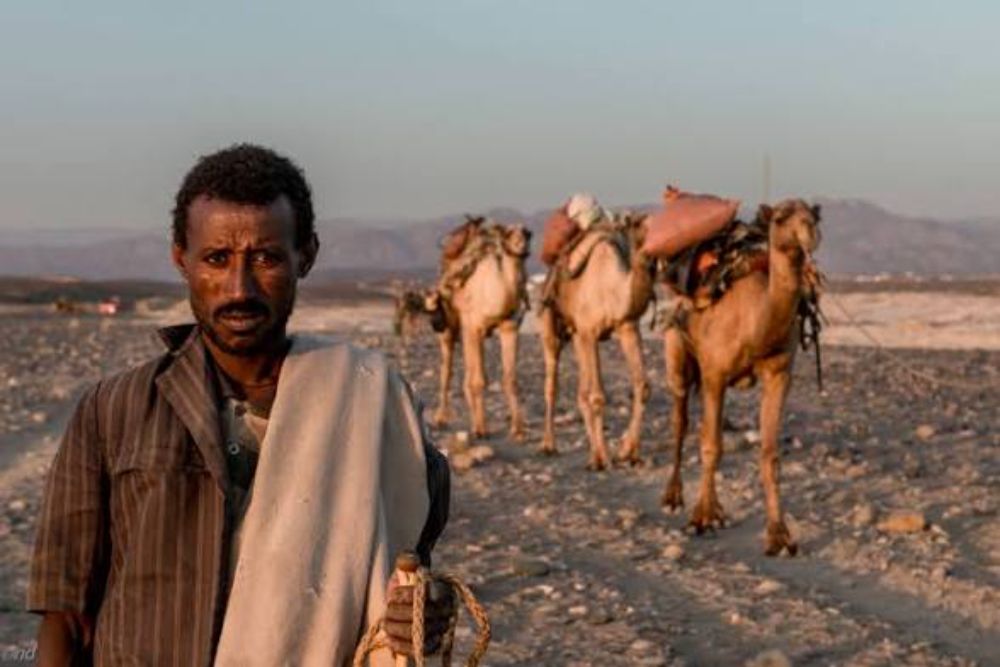
The Afar people (also known as the Danakil) are a nomadic Cushitic ethnic group residing in the Danakil Desert, a region spanning northeastern Ethiopia, northern Djibouti, and southern Eritrea. Known for their resilience, they have thrived for over 2,000 years in one of the world's most extreme environments—the Danakil Depression, where temperatures can soar above

Most Afar are pastoralists who herd camels, goats, sheep, and cattle. Their survival depends on finding water and pasture in an arid landscape where rain is rare.
For centuries, the Afar have mined salt tiles (known as amoles) from the desert's salt flats. These are transported by camel caravans across ancient routes to the highlands for trade.

Traditionally, they live in mobile, oval-shaped huts called ari, made of palm mats that can be easily dismantled and packed onto camels.
They are renowned for their martial prowess. Afar men traditionally carry the jile, a long, curved double-edged dagger, which serves as both a weapon and a symbol of status.

Afar society is organized into clans (mela) led by elders and sultans. They are divided into two main classes: the Asaimara ("Red Men"), traditionally the noble class, and the Adoimara ("White Men"), the commoners.
The Dagu is a unique cultural communication practice when two Afar meet and spend time exchanging detailed news about economic, social, and political events, acting as a traditional news network.
Beauty standards include long curly hair, which men often style using sticks and butter for protection from the sun. Historically, some also practiced tooth-filing as a mark of bravery and social status.

Afar are majorly Sunni Muslims, a faith they adopted as early as the 9th century. Most of their beliefs often blend Islamic concepts with ancient pre-Islamic rituals, such as anointing bodies with ghee, rain sacrifices, and the annual "feast of the dead" called Rabena.
Their food consists mainly of milk and meat from their livestock. Milk is a significant social offering; serving fresh warm milk to a guest symbolizes the host's commitment to provide immediate protection.

Geological features of the Danakil Depression and Travel safety:
The Danakil Depression is one of the most geologically active and extreme environments on Earth, situated at the triple junction of three tectonic plates (Arabian, Nubian, and Somalian). While it offers "alien" landscapes, visiting requires strict safety protocols due to extreme heat and regional instability.
Key Geological Features: The depression sits approximately 125 meters (410 feet) below sea level and is where the African continent is slowly splitting apart.
Dallol Hydrothermal Field is a surreal landscape of neon-colored acid pools, sulfur vents, and salt formations. The vibrant yellows, greens, and oranges are caused by mineral deposits like iron oxide and sulfur reacting with boiling, acidic brine.
Erta Ale Volcano: One of the world’s few volcanoes with a permanent lava lake. It is a broad shield volcano that travelers often hike at night to witness the glowing caldera.
Lake Assal (Djibouti): The lowest point in Africa at 155 meters below sea level. It is one of the saltiest bodies of water on Earth, even saltier than the Dead Sea.
Salt Flats (Lake Karum): Vast white plains where the Afar people still mine salt by hand, transporting it via ancient camel caravans.
How to Visit Safely: As of April 2026, major travel advisories (US, UK, and Canada) recommend avoiding all travel to Ethiopia’s border areas and the Danakil desert due to high risks of kidnapping, landmines, and armed conflict.
If you choose to visit, follow these guidelines strictly: Book with a Reputable Tour Operator: Never attempt to visit solo. Reliable operators like Great Ethiopian Tours or Ethio Danakil Tours arrange necessary permits, specialized 4x4 vehicles, and armed security escorts required by the regional government.
Timing & Climate: The best time to visit is during the "cooler" months from November to February.
Daytime temperatures can still exceed Daytime temperatures can be excruciatingly humid so staying hydrated is critical.
Physical Preparation: Hiking Erta Ale requires a good level of fitness and proper gear, including sturdy boots and a high-quality headlamp for night trekking.
Health Precautions: Ensure routine vaccinations are up to date and carry a personal supply of essential medications, as medical facilities in the Afar region are virtually non-existent.




No comments yet. Be the first to share your thoughts!