

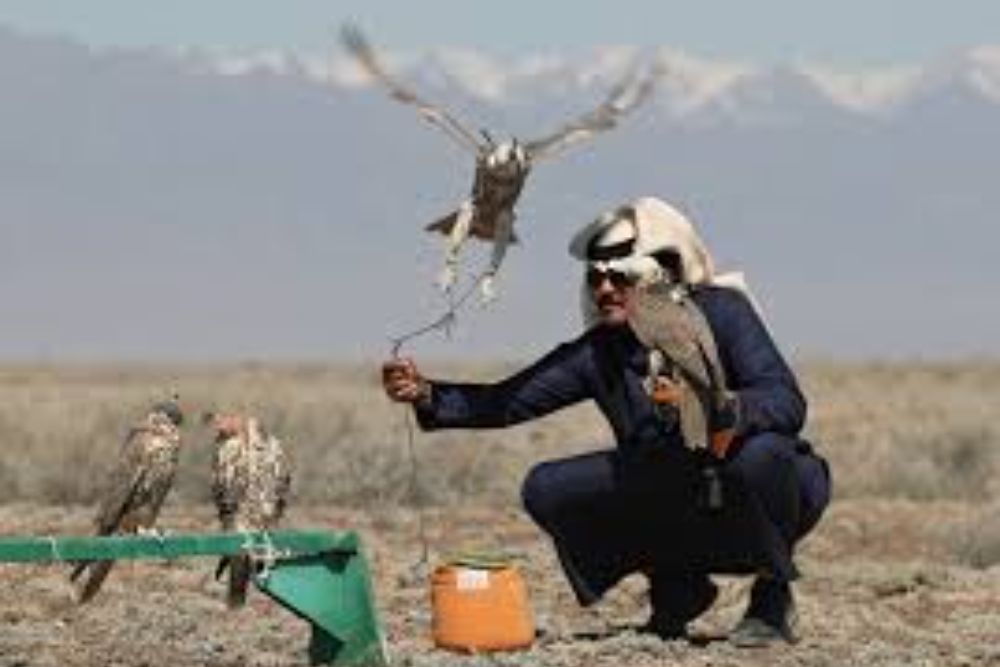
Saudi ?Falcons Club has, in partnership with a Kazakh institute,
released 34 endangered Saker Falcons into the Kazakhstani rocky desert landscape of
Altyn-Emel National Park in southeastern Kazakhstan.
This is part of a saker falcon restoration programme by
the Saudi state-run club to boost the population of this endangered "Red
List" species. The group plans to release 35 to 45 birds annually over the
next three years.
The released birds were fitted
with GPS ?trackers and microchips, allowing scientists to
collect data on their migration patterns and other behaviours.
The Saker Falcons, which for
centuries symbolize nobility and freedom for the nomadic peoples of the Kazakh
grassland, serving as very dependable hunting companions, is a medium-sized bird of prey. The once common species,
with global population estimated at tens of thousands of pairs, progressively
became rare, and in some areas, completely extinct. Today, the International
Union for the Conservation of Nature (IUCN) classifies the Saker Falcon as “Endangered,” the only falcon
species so termed.
Similarly, the Red Book of Kazakhstan classifies the Saker
Falcon as “Endangered,” due to a steep drop in population in the country,
estimated to be about 90 percent.
The Saker Falcon’s color varies greatly—from very light to very
dark—depending on its region of habitat and individually. The birds live
up to 18–20 years in the wild and up to 30 years in captivity. The raptor is a
universal hunter, overtaking victims both on the ground and in the air. It
hunts rodents, hares and pikas, small and medium-sized birds, and reptiles.
The Saker Falcons population in
Kazakhstan decreased by 73-79 percent from 1990-2012. In 2012, it was about
1,000-1,500 breeding pairs, and by 2023, the number plummeted to an estimated
number of less than 650 pairs.




No comments yet. Be the first to share your thoughts!