

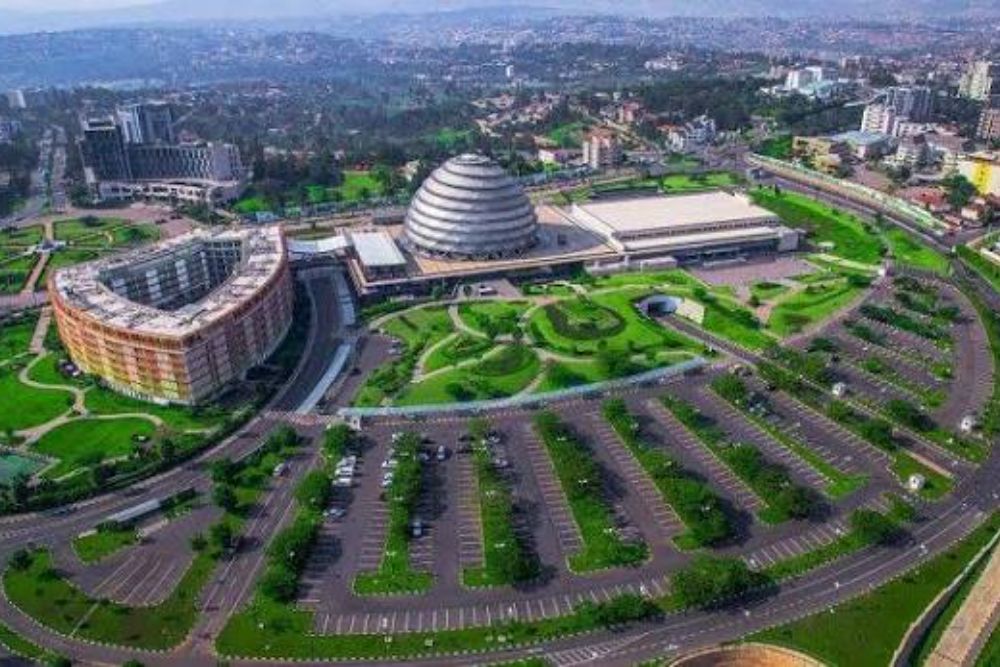
Rwanda is a land of contrasts. Landlocked and mountainous, its borders encompass ancient rainforests and national parks that are home to iconic wildlife such as the mountain gorilla and the golden monkey. It is also a growing industrial base and one of the world’s fastest-growing economies.
Rwanda has long demonstrated strong environmental leadership, placing care for people and the planet at the center of its development pathway. Its 2008 ban on single-use plastic bags and bottles paved the way for better management of plastic pollution in Africa, while its urban waste-management system is so effective that the capital Kigali is considered one of Africa’s cleanest cities. The country is now working to broaden this focus to fast-growing industrial sectors, with support for cleaner production methods, safer alternatives to toxic materials, and improved handling of hazardous waste.
To strengthen these efforts, the Government of Rwanda, through the Rwanda Environment Management Authority, is implementing the five-year initiative: Supporting a Green Economy – Decoupling Hazardous Waste Generation from Economic Growth in Rwanda, to promote pollution-free value chains in Rwanda. Funded by the Global Environment Facility and implemented with support from the United Nations Development Programme, the project aims to strengthen systems for the safe management of hazardous waste while promoting cleaner production and circular economy practices.
Since its launch in 2022, the initiative has generated tangible results. Significant amounts of hazardous waste, including plastics containing hazardous chemicals, obsolete pesticides, mercury, and expired laboratory chemicals from schools, have been collected and treated through partnerships with specialized waste-management companies.
Capacity building has been central to the project’s approach. More than 4,000 stakeholders, including teachers, customs officials, healthcare workers, environmental practitioners, and waste collectors, were trained in hazardous waste and chemicals management. At the same time, national awareness campaigns and digital outreach have reached over 2.3 million people, helping to strengthen public understanding of responsible waste management and environmental protection.
Beyond these immediate results, the project is helping Rwanda build the institutional and regulatory capacity needed for long-term environmental sustainability. Efforts are underway to strengthen national frameworks governing hazardous chemicals, including mercury and polychlorinated biphenyls (PCBs), and substances regulated under the Minamata and Stockholm Conventions to minimize the adverse human health and environmental impacts.
For example, with support from the project, the Rwanda Environment Management Authority and the Rwanda Information Society have built an online platform to track the import, use, and sale of plastic and toxic materials. A country-wide inventory is in the works for all potential sources of hazardous waste – from the agriculture and manufacturing sectors to hospitals and schools.
Soon, producers and importers will be required to take greater responsibility for financing, managing and disposing of their waste safety, through an Extended Producer Responsibility framework to be explored under this project. This is being complemented with communications and training programs that support organizations to adopt cleaner production methods and develop safer, greener alternatives to hazardous materials.
Customs authorities are also receiving specialized training, to identify dangerous pollutants and prohibited substances at the border, enabling them to alert the Rwanda Environment Management Authority when regulatory action is required. At the same time, incentive programs are being introduced, encouraging industries to move away from the traditional manufacture–use–discard model and toward a circular approach based on the ‘4R’ principles: reduce, reuse, recycle, and recover.
To further enhance national capacity, Rwanda is advancing plans to establish a national interim storage facility for hazardous waste, providing a safe space for sound storage of hazardous chemicals and waste awaiting final treatment and disposal. This will be complemented by enhanced private sector capacity to safely treat and dispose of hazardous waste and chemicals in the long-term.
As Rwanda moves into the next phase of its green transition, the lessons emerging from this initiative extend well beyond its borders. By integrating hazardous waste management, cleaner production, and circular economy principles into national development planning, the country is demonstrating a replicable approach for other rapidly industrializing economies.
These approaches provide a scalable model for other rapidly industrializing countries in Africa seeking to align economic growth with global chemicals and waste commitments. Through continued partnership, innovation, and policy leadership, Rwanda is helping chart a course toward a more circular, resilient, and pollution?free future for Africa.
Story Credit: www.thegef.com



No comments yet. Be the first to share your thoughts!