

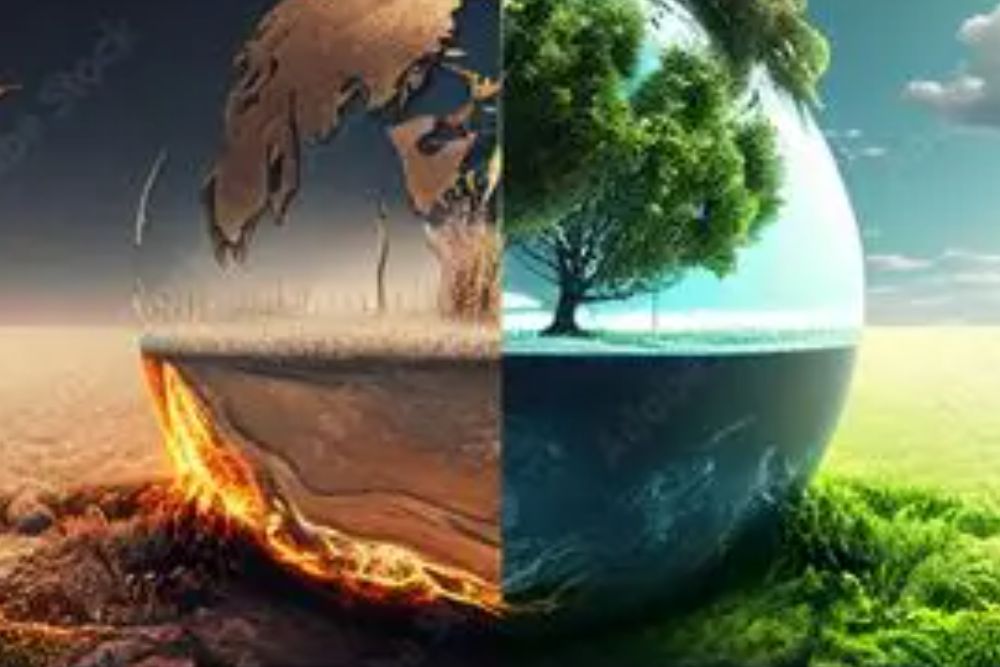
Climate change is a long-term shift in Earth's weather, primarily driven by human activities like burning fossil fuels, which release greenhouse gases. Natural factors also play a role. Scientists use data & models to understand this and agree human action is the main cause. It's warming the planet rapidly.
Climate change is a long-term change in the average weather
patterns that have come to define Earth’s local, regional and global climates.
These changes have a broad range of observed effects that are synonymous with
the term.
Changes observed in Earth’s climate since the
mid-20th century are driven by human activities, particularly fossil fuel
burning, which increases heat-trapping greenhouse gas levels in Earth’s
atmosphere, raising Earth’s average surface temperature. Natural processes,
which have been overwhelmed by human activities, can also contribute to climate
change, including internal variability (e.g., cyclical ocean patterns like El
Niño, La Niña and the Pacific Decadal Oscillation) and external forcings (e.g.,
volcanic activity, changes in the
Sun’s energy output, variations in
Earth’s orbit).
Scientists use observations from the ground, air,
and space, along with computer models,
to monitor and study past, present, and future climate change. Climate data
records provide evidence of climate change key indicators, such as global land
and ocean temperature increases; rising sea levels; ice loss at Earth’s poles
and in mountain glaciers; frequency and severity changes in extreme weather
such as hurricanes, heatwaves, wildfires, droughts, floods, and precipitation;
and cloud and vegetation cover changes.
“Climate change” and “global warming” are often used
interchangeably but have distinct meanings. Similarly, the terms
"weather" and "climate" are sometimes confused, though they
refer to events with broadly different spatial- and timescales.
What
Is Global Warming?
Global warming is the long-term heating of Earth’s surface
observed since the pre-industrial period (between 1850 and 1900) due to human
activities, primarily fossil fuel burning, which increases heat-trapping
greenhouse gas levels in Earth’s atmosphere. This term is not interchangeable
with the term "climate change."
Since the pre-industrial period, human activities
are estimated to have increased Earth’s global average temperature by about 1
degree Celsius (1.8 degrees Fahrenheit), a number that is currently increasing
by more than 0.2 degrees Celsius (0.36 degrees Fahrenheit) per decade. The
current warming trend is unequivocally the result of human activity since the
1950s and is proceeding at an unprecedented rate over millennia.
Weather vs. Climate
Weather refers to atmospheric conditions that occur locally over
short periods of time—from minutes to hours or days. Familiar examples include
rain, snow, clouds, winds, floods, or thunderstorms.
Climate, on the other hand, refers to the long-term
(usually at least 30 years) regional or even global average of temperature,
humidity, and rainfall patterns over seasons, years, or decades.
Evidence
There is unequivocal evidence that Earth is warming at an
unprecedented rate. Human activity is the principal cause.
Takeaways
- While
Earth’s climate has changed
throughout its history, the current warming is happening at a
rate not seen in the past 10,000 years.
- According
to the Intergovernmental Panel on Climate Change (IPCC), "Since systematic scientific
assessments began in the 1970s, the influence of human activity on the
warming of the climate system has evolved from theory to established fact."1
- Scientific
information taken from natural sources (such as ice cores, rocks, and tree
rings) and from modern equipment (like satellites and instruments) all
show the signs of a changing climate.
- From
global temperature rise to melting ice sheets, the evidence of a warming
planet abounds.
The rate of change since the mid-20th century is
unprecedented over millennia.
Earth's climate has changed throughout history. Just
in the last 800,000 years, there have been eight cycles of ice ages and warmer
periods, with the end of the last ice age about 11,700 years ago marking the
beginning of the modern climate era — and of human civilization. Most of these
climate changes are attributed to very small
variations in Earth’s orbit that change the amount of solar energy
our planet receives.
The
current warming trend is different because it is clearly the result of human
activities since the mid-1800s, and is proceeding at a rate not seen over many
recent millennia.1 It is undeniable that human activities
have produced the atmospheric gases that have trapped more of the Sun’s energy
in the Earth system. This extra energy has warmed the atmosphere, ocean, and
land, and widespread and rapid changes in the atmosphere, ocean, cryosphere,
and biosphere have occurred.
Do scientists agree on climate change?
Earth-orbiting
satellites and new technologies have helped scientists see the big picture,
collecting many different types of information about our planet and its climate
all over the world. These data, collected over many years, reveal the signs and
patterns of a changing climate.
Scientists
demonstrated the heat-trapping nature of carbon dioxide and other gases in the
mid-19th century.2 Many
of the science instruments NASA uses to study our climate focus on how these
gases affect the movement of infrared radiation through the atmosphere. From
the measured impacts of increases in these gases, there is no question that
increased greenhouse gas levels warm Earth in response.
To
be continued tomorrow. Keep a date with us HERE




No comments yet. Be the first to share your thoughts!