

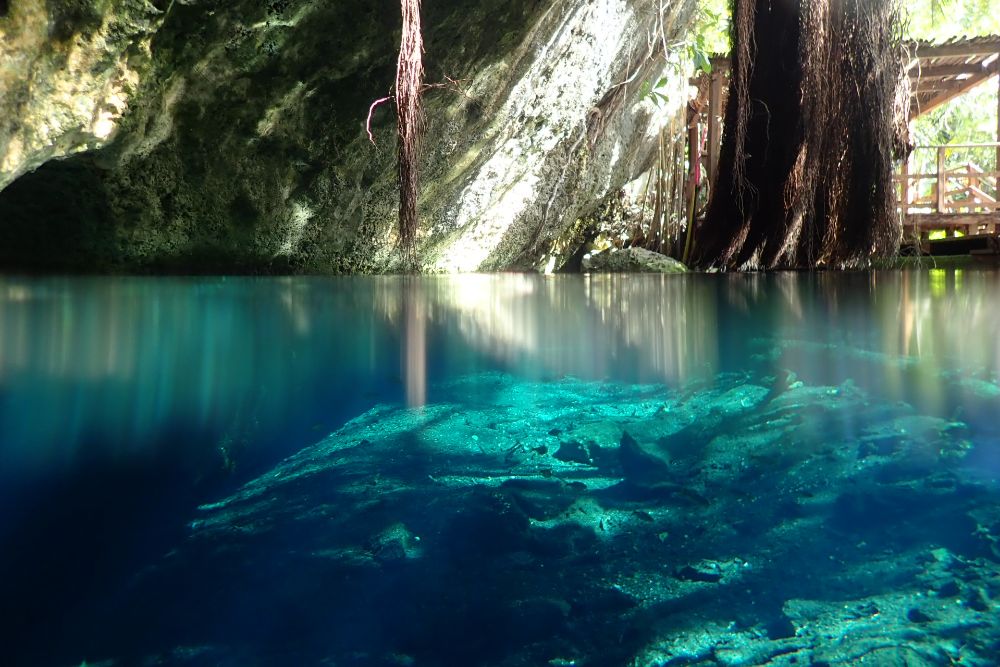
Shrimp may be tiny, but beneath the forests of Mexico’s Yucatan Peninsula, they keep a hidden world alive.
Anchialine caves are dark, flooded systems where fresh and saltwater mix, often hidden within underwater sinkholes.
Though they have little or no direct connection to the open ocean, the caves are still influenced by the tides. Life has thrived in these isolated environments for millions of years.
Life without sunlight: In most places on Earth, life begins with sunlight. Plants capture that energy, and everything else builds from there.

Shrimp may be tiny, but beneath the forests of Mexico’s Yucatan Peninsula, they keep a hidden world alive.
Anchialine caves are dark, flooded systems where fresh and saltwater mix, often hidden within underwater sinkholes.
Though they have little or no direct connection to the open ocean, the caves are still influenced by the tides. Life has thrived in these isolated environments for millions of years.
Life without sunlight: In most places on Earth, life begins with sunlight. Plants capture that energy, and everything else builds from there.
But these caves play by different rules. There’s no sunlight here, so the system depends on chemistry instead.
Leaves and organic debris from the forest above break down and seep through porous limestone. This process carries methane into the caves.
Specialized bacteria feed on the methane and turn it into energy. These bacteria form the base of the food web.
That’s where a small shrimp steps in and changes everything.
The shrimp that holds it together: The anchialine cave shrimp, part of the genus Typhlatya, plays a central role in this hidden ecosystem. It scrapes bacterial mats off cave surfaces and turns that microbial growth into something bigger animals can eat.
“My first impression of these incredibly beautiful places was that I had to work there to find out how that rich crustacean fauna had evolved in those exceptionally large cave systems,” said marine biologist Fernando Álvarez, co-author of a recent study.
These shrimp act as a bridge. Without them, the energy locked in bacteria would struggle to move up the food chain. With them, larger predators have something to feed on.
“What we see now is that Typhlatya shrimps are a key component of the anchialine trophic web,” said Álvarez.
In collaboration with Brenda Durán at the Universidad Nacional Autónoma de México, Álvarez looked closely at what these shrimp eat.
The researchers used stable isotope analysis, which tracks chemical signatures in tissue, to map out their diets.
Different diets in the dark: Even in a place with limited food, not all shrimp eat the same thing. Each species has carved out its own niche.
Some stay in shallower areas and feed on decaying plant matter and certain bacteria. Others move deeper, gathering food where fresh and saltwater meet.
Another group sticks closer to cave ceilings, feeding heavily on methane-based bacterial growth. This division helps them avoid competition. It’s a quiet balance, but it works.
“Over the years my research has evolved from very descriptive taxonomic studies… to more ecological studies about the interactions among species,” noted Álvarez.
Their diets stay steady through rainy and dry seasons, which is surprising given how much surface conditions can change. But geography matters.
Anchialine caves are dark, flooded systems where fresh and saltwater mix, often hidden within underwater sinkholes.
Though they have little or no direct connection to the open ocean, the caves are still influenced by the tides. Life has thrived in these isolated environments for millions of years.
Life without sunlight: In most places on Earth, life begins with sunlight. Plants capture that energy, and everything else builds from there.
But these caves play by different rules. There’s no sunlight here, so the system depends on chemistry instead.
Leaves and organic debris from the forest above break down and seep through porous limestone. This process carries methane into the caves.
Specialized bacteria feed on the methane and turn it into energy. These bacteria form the base of the food web.
That’s where a small shrimp steps in and changes everything.
The shrimp that holds it together: The anchialine cave shrimp, part of the genus Typhlatya, plays a central role in this hidden ecosystem. It scrapes bacterial mats off cave surfaces and turns that microbial growth into something bigger animals can eat.
“My first impression of these incredibly beautiful places was that I had to work there to find out how that rich crustacean fauna had evolved in those exceptionally large cave systems,” said marine biologist Fernando Álvarez, co-author of a recent study.
These shrimp act as a bridge. Without them, the energy locked in bacteria would struggle to move up the food chain. With them, larger predators have something to feed on.
“What we see now is that Typhlatya shrimps are a key component of the anchialine trophic web,” said Álvarez.
In collaboration with Brenda Durán at the Universidad Nacional Autónoma de México, Álvarez looked closely at what these shrimp eat.
The researchers used stable isotope analysis, which tracks chemical signatures in tissue, to map out their diets.
Different diets in the dark: Even in a place with limited food, not all shrimp eat the same thing. Each species has carved out its own niche.
Some stay in shallower areas and feed on decaying plant matter and certain bacteria. Others move deeper, gathering food where fresh and saltwater meet.
Another group sticks closer to cave ceilings, feeding heavily on methane-based bacterial growth. This division helps them avoid competition. It’s a quiet balance, but it works.
“Over the years my research has evolved from very descriptive taxonomic studies… to more ecological studies about the interactions among species,” noted Álvarez.
Their diets stay steady through rainy and dry seasons, which is surprising given how much surface conditions can change. But geography matters.
Shrimp living in isolated sinkholes behave differently from those in large, connected cave systems.
An ancient lineage under pressure: Anchialine cave shrimp are not new arrivals. Their relatives date back to the time of the dinosaurs and live in scattered regions across the globe, from the Mediterranean to Australia.
The shrimp have survived massive changes over millions of years. Now they face something far more sudden.
The Yucatan Peninsula is changing fast. Urban growth is cutting down forests, polluting water, and damaging the land above these caves. That matters more than it might seem. The caves depend entirely on what filters down from the surface.
If the forest disappears, the food supply collapses. If pollution seeps in, the delicate balance breaks.
Anchialine caves are dark, flooded systems where fresh and saltwater mix, often hidden within underwater sinkholes.
Though they have little or no direct connection to the open ocean, the caves are still influenced by the tides. Life has thrived in these isolated environments for millions of years.
Life without sunlight: In most places on Earth, life begins with sunlight. Plants capture that energy, and everything else builds from there.
But these caves play by different rules. There’s no sunlight here, so the system depends on chemistry instead.
Leaves and organic debris from the forest above break down and seep through porous limestone. This process carries methane into the caves.
Specialized bacteria feed on the methane and turn it into energy. These bacteria form the base of the food web.
That’s where a small shrimp steps in and changes everything.
The shrimp that holds it together: The anchialine cave shrimp, part of the genus Typhlatya, plays a central role in this hidden ecosystem. It scrapes bacterial mats off cave surfaces and turns that microbial growth into something bigger animals can eat.
“My first impression of these incredibly beautiful places was that I had to work there to find out how that rich crustacean fauna had evolved in those exceptionally large cave systems,” said marine biologist Fernando Álvarez, co-author of a recent study.
These shrimp act as a bridge. Without them, the energy locked in bacteria would struggle to move up the food chain. With them, larger predators have something to feed on.
“What we see now is that Typhlatya shrimps are a key component of the anchialine trophic web,” said Álvarez.
In collaboration with Brenda Durán at the Universidad Nacional Autónoma de México, Álvarez looked closely at what these shrimp eat.
The researchers used stable isotope analysis, which tracks chemical signatures in tissue, to map out their diets.
Different diets in the dark: Even in a place with limited food, not all shrimp eat the same thing. Each species has carved out its own niche.
Some stay in shallower areas and feed on decaying plant matter and certain bacteria. Others move deeper, gathering food where fresh and saltwater meet.
Another group sticks closer to cave ceilings, feeding heavily on methane-based bacterial growth. This division helps them avoid competition. It’s a quiet balance, but it works.
“Over the years my research has evolved from very descriptive taxonomic studies… to more ecological studies about the interactions among species,” noted Álvarez.
Their diets stay steady through rainy and dry seasons, which is surprising given how much surface conditions can change. But geography matters.
Shrimp living in isolated sinkholes behave differently from those in large, connected cave systems.
An ancient lineage under pressure: Anchialine cave shrimp are not new arrivals. Their relatives date back to the time of the dinosaurs and live in scattered regions across the globe, from the Mediterranean to Australia.
The shrimp have survived massive changes over millions of years. Now they face something far more sudden.
The Yucatan Peninsula is changing fast. Urban growth is cutting down forests, polluting water, and damaging the land above these caves. That matters more than it might seem. The caves depend entirely on what filters down from the surface.
If the forest disappears, the food supply collapses. If pollution seeps in, the delicate balance breaks.
“We are losing the vertical integrity that these anchialine caves need to function; any changes occurring on the surface within the caves’ area will inevitably affect them,” said Álvarez.
A fragile link between worlds: The caves and the forest above them are tightly connected. What happens on the surface doesn’t stay there. It moves downward, shaping life in the dark.
“The Yucatan Peninsula is an area of extraordinary cultural wealth and contains sophisticated and unique ecosystems as the anchialine caves, but sadly all this is disappearing,” said Álvarez.
Protecting these shrimp means protecting the forest. It means keeping the flow of nutrients clean and steady. Without that connection, the entire system could fail.
The caves may be hidden, but they are not separate. Their survival depends on the same sunlight, soil, and water that shape the world above.
The full study was published in the journal Subterranean Biology.
Credit: Rodielon Putol, Earth.com



No comments yet. Be the first to share your thoughts!