

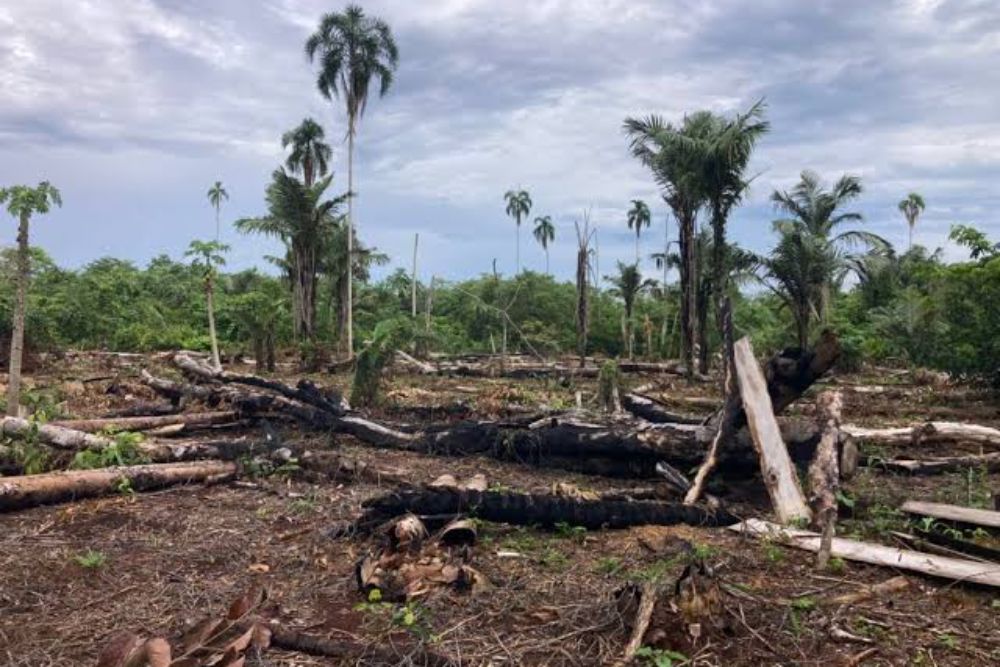
Over the last few decades, wildfires, farmers, and cattle ranchers have razed millions of acres of tropical forests across the planet. Much of that deforestation has occurred in three countries: Brazil, Democratic Republic of the Congo, and Indonesia.
But in the last few years, another, smaller nation has risen in the ranks of nations with the most severe forest loss — Bolivia.
Situated just west of Brazil, Bolivia lost 1.5 million acres of primary forest in 2025 alone, more than any other country aside from Brazil, according to a new analysis by the University of Maryland and the World Resources Institute (WRI), a research group. That’s just shy of the surface area of Delaware.
Those lost acres in Bolivia are part of threatened and globally important ecosystems, including the Amazon rainforest and the Chiquitano dry forests. They are rich not only in wildlife — including the elusive maned wolf, a long-legged canine that is actually not a wolf — but also in carbon. After trees are cleared, much of the carbon they store returns quickly to the atmosphere, accelerating climate change. (Not-so-fun fact: Yearly carbon emissions from deforestation in the tropics are greater than the output from the entire European Union.)
On the surface, the story of deforestation in Bolivia mirrors that of other tropical countries: People are knocking down trees there to make way for cattle ranches and farms, the two leading drivers of tropical forest loss. Often, people clear land with fire. And as climate change makes droughts more severe in places like Bolivia, those fires more easily spread out of control and into areas that weren’t meant to burn, taking out even larger stretches of primary forest.
But when you look more closely at who, exactly, is fueling much of the recent deforestation, Bolivia starts to stand out — thanks to an unexpected player.
The white religious sect cutting down Bolivia’s trees
The main reason people clear forests in Bolivia is to make way for cattle. It’s typically cheaper to buy forested land and remove the trees than to acquire existing pasture, says Daniel Larrea, science and technology program director at Conservación Amazónica, a Bolivian NGO. Plus, under the country’s legal system, landowners risk losing their land in Bolivia if they don’t demonstrate that they’re using it “productively,” such as by raising cattle for beef, effectively creating an incentive for deforestation.
The other major source of forest loss in Bolivia is the rapid expansion of soy farms, the nation’s top export crop, by weight. Between 2001 and 2021, soy farms in Bolivia — which feed global demand for animal feed and soybean oil — destroyed some 2.2 million acres of forests, according to a 2023 report by the nonprofit Amazon Conservation Association (affiliated with Conservación Amazónica). That’s roughly the size of Puerto Rico.
Soy farming is among the leading causes of deforestation across the tropics, in places like Brazil, Argentina, and parts of Africa. What makes it more unusual in Bolivia is the people behind much of its production and related environmental harm: Mennonites.
A mostly white Christian group, Mennonites — who have similar origins to the Amish — started migrating to Latin America from Canada in the early 1900s. They first settled in Mexico and Paraguay and then later expanded into a number of other South American countries, including Peru and Bolivia, in the mid-20th century. Bolivia is now home to the largest and fastest-growing community of Mennonites in Latin America, says Yann le Polain de Waroux, a geographer at McGill University, who has studied Mennonites.




No comments yet. Be the first to share your thoughts!