

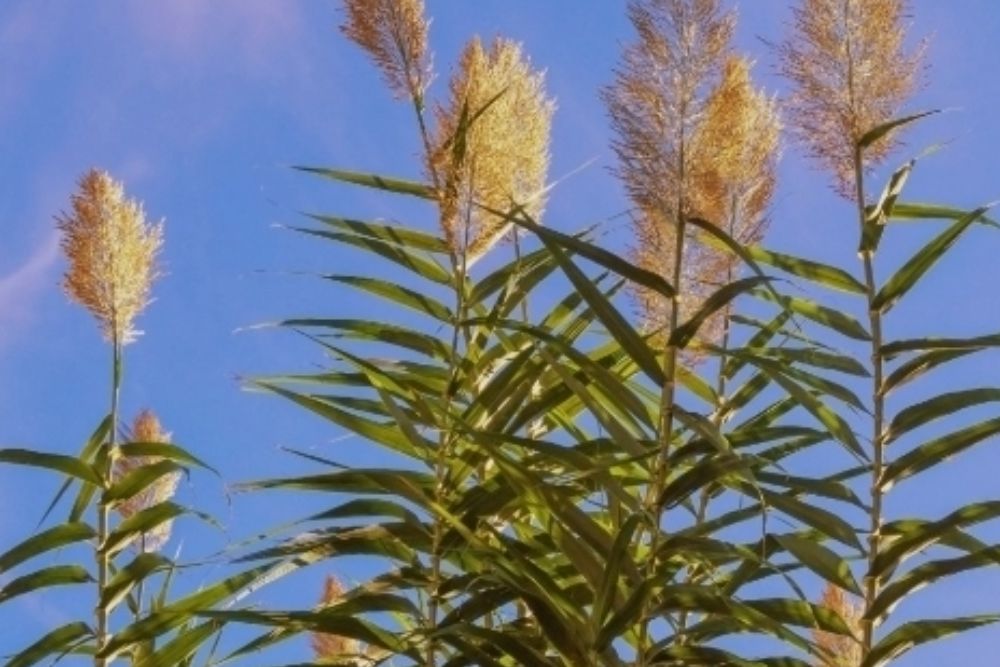
One of these invasive river plants, Arundo donax, has spread widely across parts of Europe and beyond. At first glance, it looks harmless. New research now shows a different story.
Mediterranean streams often look calm and familiar. Tall green reeds line the banks. They sway with the wind and seem like they belong there. But many of these plants are not native.
One of these invasive river plants, Arundo donax, has spread widely across parts of Europe and beyond. At first glance, it looks harmless. New research now shows a different story.
This plant does more than replace native species. It can also change how mosquitoes grow and survive. That link may affect both ecosystems and human health.
The giant reed invasion
Arundo donax, known as giant reed, spreads fast and dominates riverbanks. It pushes out native plants like Phragmites australis, which has supported these ecosystems for thousands of years
The two plants look very similar. Many people cannot tell them apart. This similarity hides a key problem. When one replaces the other, the effects go beyond plant life.
Researchers at the University of Barcelona tested this idea in a controlled setup. They created small aquatic systems using glass jars.
Each jar contained water and different mixes of fallen leaves from the two reed species.
These leaves acted like they do in nature. They sank, broke down, and released nutrients into the water. This process set the stage for everything that followed.
Microbes fill the water
As the leaves decomposed, microscopic organisms began to grow. These included flagellates, ciliates, and amoebae. Together, they form an important part of aquatic food webs.
They feed on bacteria and support larger organisms. In simple terms, they help turn dead plant matter into usable energy for other life forms.
Jars with the invasive reed showed much higher numbers of these microbes. The invader created richer feeding conditions.
After two weeks, researchers added larvae of Culex pipiens. This common mosquito species can spread diseases such as West Nile virus and avian malaria.
The results were clear. In jars without leaf material, all larvae died. They had no food source. The microbial life created by decomposing leaves was essential for their survival.
Faster growth observed in larvae
Larvae in jars with invasive reed leaves performed better. They developed more quickly. More of them reached the pupal stage. The pupae were also heavier.
This detail matters. Larger mosquitoes tend to live longer and produce more eggs. This increases their population over time.
“This effect was catalyzed by changes in water quality and in the abundance of certain groups of microeukaryotes, such as flagellates and amoebae, which form part of the microbial food webs on which the larvae of the common mosquito Culex pipiens feed,” explained Professor Alberto Maceda-Veiga.
Small change, big impact
The researchers expected gradual changes as more invasive leaves were added. Instead, they saw a sharp shift.
When just twenty five percent of the leaf material came from the invasive plant, mosquito growth changed significantly. Beyond this point, the system stayed in this new state.
This finding raises concerns. Removing only part of the invasive plant may not reduce its effects.
Implications for human health
Mosquito population growth is not just an ecological issue. It can also affect human health.
“It is important to remember that the common mosquito can act as a vector for diseases of medical and veterinary significance,” said Maceda-Veiga.
“Identifying which plants encourage the proliferation of mosquitoes helps pest control services to predict where they are most likely to find larvae and to apply control measures, where necessary.”
Pollution worsens the problem
In polluted waterways, the problem can worsen. Natural predators such as fish and dragonflies are often missing.
“In freshwater ecosystems most severely affected by chemical pollution, the natural aquatic predators of the larvae, such as fish and dragonflies, are often absent,” noted Maceda-Veiga.
“Many larvae mean many adult mosquitoes, which can cause nuisance to humans and even pose health risks.”
Limits of plant control
Plants alone do not decide mosquito populations. Many factors shape these ecosystems. The researchers emphasized that this is only one piece of the puzzle.
“When the eradication of an invasive species is not feasible, we turn to mitigation measures,” said Maceda-Veiga.
“In the case of mosquitoes, we must not give in to alarmism. In nature, mosquitoes have many predators.” This balance still exists in healthier systems.
Invasive plant boosts mosquito impacts
This study shows how a single change can ripple through an entire ecosystem. One plant replaces another, and its leaves fall into the water, where they begin to decompose.
Microbes respond to this new source of nutrients and multiply. Mosquitoes then feed on these microbes and grow faster.
Over time, this chain of events extends beyond the ecosystem and begins to affect human health. Such links are easy to miss. The landscape may look the same but the consequences are not.
Understanding these connections helps us see ecosystems more clearly. It also reminds us that even small changes can lead to larger effects over time.
By Sanjana Gajbhiye, Earth.com staff writer. The study is published in the journal NeoBiota.




No comments yet. Be the first to share your thoughts!